
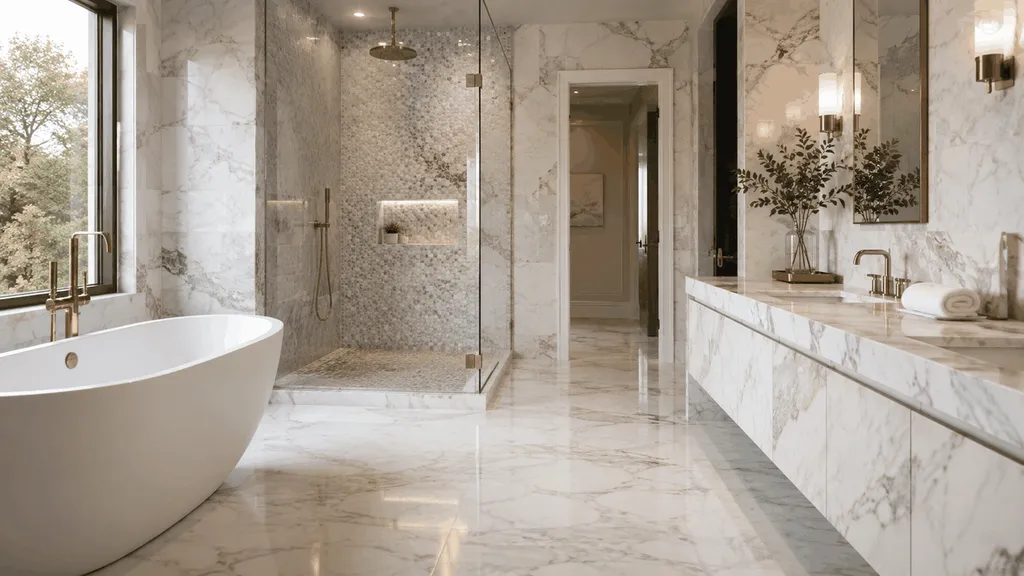
Finding beautiful marble is easy. Choosing the right marble for a particular room, finish, lighting condition, installation method, and lifestyle is considerably harder.
That distinction matters.
When homeowners start searching for marble tile for sale, they are often drawn immediately to photographs of white stone, dramatic veining, glossy surfaces, and perfectly styled bathrooms. Yet marble is a natural material. Two tiles carrying exactly the same stone name can have noticeably different veins, shades, movement, and character.
That unpredictability is also part of its appeal.
A well-chosen marble floor or wall does not look printed or artificially repeated. It has depth. One tile may carry a fine gray line across the surface while the neighboring piece has a cloudy mineral pattern. Viewed together, those differences create a surface that feels individual rather than manufactured.
The real question is therefore not simply, “Which marble looks best?”
It is: Which marble works best for this particular project?
Understanding that before ordering can prevent expensive mistakes and lead to a finished room that looks far more intentional.
Why Natural Marble Still Feels Different
There are many materials designed to reproduce the appearance of stone. Some do it remarkably well.
But reproduction and natural material are not quite the same thing.
Marble develops through geological processes that create variations in mineral composition, veining, shade, and movement. This means each installation has its own character. Carrara White may create a restrained, soft-gray background, while Calacatta Gold can introduce stronger movement and warmer veins. Thassos White creates a considerably cleaner white appearance, while darker varieties such as Nero Marquina or Emperador Dark can turn the stone itself into the visual focus of a room.
This variety explains why searching for marble tile for sale should involve more than selecting a color.
Consider the atmosphere you want to create.
A bright bathroom with white cabinetry may benefit from subtle Carrara veining. A large entrance hall could support more dramatic stone. A traditional kitchen may feel warmer with cream or beige marble, while a modern monochrome interior can use black-and-white stone to create contrast.
The best stone often responds to the room rather than dominating it.
Polished or Honed Marble? The Finish Changes Everything
Two tiles made from the same marble can feel surprisingly different when one is polished and the other honed.
Polished Marble
Polished marble has a reflective surface that intensifies color and veining. Light moves across it, giving walls and floors a richer appearance.
This can work beautifully for:
• Feature walls• Kitchen backsplashes• Decorative bathroom walls• Fireplace surrounds• Formal entrance areas
There is a certain drama to polished stone.
Walk into a room where sunlight hits a polished marble wall and you immediately notice the depth of the material.
However, reflective surfaces also reveal fingerprints, water spots, and certain types of wear more readily. In wet flooring applications, surface characteristics should also be carefully considered before installation.
Honed Marble
Honed marble has a smoother matte appearance with less reflection.
The effect is quieter.
Some designers prefer it precisely for that reason. Honed surfaces can make an expensive stone feel relaxed rather than formal. They work especially well in bathrooms, larger floors, contemporary interiors, and spaces where the marble should contribute texture without becoming excessively glossy.
When comparing marble tile for sale, look at both finishes whenever possible.
A homeowner may enter the process convinced that polished Calacatta is the obvious choice and then discover that the honed version looks far better beside matte cabinetry and brushed-metal fixtures.
That happens more often than people expect.
Marble Mosaic Tile Can Solve Design Problems That Large Tiles Cannot
Large marble tiles create broad uninterrupted surfaces. Mosaics do something very different.
A marble mosaic tile introduces pattern, scale, grout lines, and visual rhythm. It can turn an otherwise simple material into a decorative feature without requiring another color or material.
Common marble mosaic formats include herringbone, hexagon, penny-round, basketweave, octagon, lantern, pinwheel, geometric patterns, and smaller traditional squares. Collections can also combine contrasting stones to create stronger patterns.
This flexibility makes mosaics particularly useful in smaller architectural areas.
Think about a shower niche.
Covering the entire bathroom in an intricate pattern might feel overwhelming. Using that same pattern inside the niche creates a carefully placed detail that catches attention without taking over the space.
The same principle works behind a range.
A kitchen may use simple rectangular marble across most of the backsplash, then introduce a marble mosaic tile behind the cooktop. Suddenly the backsplash has a focal point without adding a completely different material.
Where Marble Mosaic Works Particularly Well
Shower Floors
Small mosaic pieces allow an installer to follow the slope toward a shower drain more easily than large-format tiles.
They also create more grout joints across the floor.
For wet areas, however, the specific marble, finish, installation method, waterproofing system, maintenance requirements, and slip characteristics all need to be discussed with an experienced installer.
A beautiful material is only successful when it is appropriate for the location.
Kitchen Backsplashes
A backsplash is one of the easiest places to introduce marble without covering a huge area.
This is where homeowners can often afford to choose a more distinctive pattern or stone because the total square footage is relatively modest.
Imagine a kitchen with warm white cabinets, oak flooring, and understated countertops. Adding a Calacatta-inspired herringbone backsplash gives the room texture while allowing the cabinetry and flooring to remain calm.
It is a small architectural decision with a surprisingly large visual effect.
Bathroom Feature Walls
A mosaic behind a vanity can define the area without physically separating it.
Patterns such as hexagons or elongated pieces can also change the apparent proportions of a room. Vertical arrangements draw the eye upward, while broader horizontal layouts can visually widen a wall.
Do Not Expect Every Marble Tile to Look Identical
This may be the most important point when considering marble tile for sale.
Natural variation is normal.
Color, veins, shade, texture, edges, thickness, and surface appearance can differ between pieces and production batches. That does not automatically indicate poor quality. It reflects the nature of real stone.
In fact, trying to make natural marble look perfectly uniform can work against the material.
A good installation usually involves laying several pieces out before permanently fixing them in place. The installer can then distribute strongly veined pieces, lighter pieces, darker areas, and unusual patterns across the room.
This process is sometimes called dry laying.
It matters.
Suppose a customer orders enough Carrara marble for a bathroom floor and the installer simply takes tiles from the first box one after another. Three heavily veined tiles might end up together while the rest of the floor is relatively quiet.
Nothing is technically wrong with the stone.
But visually, the floor looks unbalanced.
Spread those same three pieces throughout the room and the result can be beautiful.
Order Samples Before Making the Final Decision
Product photography helps narrow the options, but a screen cannot accurately reproduce everything about natural stone.
If you plan to buy marble tiles online, ordering samples first is one of the smartest steps you can take.
Do not simply place the sample on a desk, look at it for thirty seconds, and decide.
Move it around.
Put a floor sample on the actual floor. Hold a backsplash sample vertically against the wall. Look at it beside cabinets, countertops, wood flooring, metal fixtures, paint samples, and furniture.
Then look again in the evening.
Natural stone can appear surprisingly different under daylight, warm artificial lighting, and cooler LEDs.
A gray vein that seemed neutral in a showroom photograph might appear slightly blue beside warm beige cabinets. Cream-colored marble may suddenly reveal yellow undertones beside a cool white countertop.
As one designer might tell a hesitant homeowner:
“Don't choose the marble in isolation. Choose the marble inside the room.”
That simple approach prevents many color mistakes.
Buying Marble Online Requires More Than Comparing Prices
The ability to buy marble tiles online has made access to natural stone much easier. Customers can compare materials, patterns, sizes, finishes, and applications without driving between multiple tile showrooms.
But price should not become the only filter.
When comparing marble tile for sale, examine what you are actually receiving.
Look at:
• Stone variety• Finish• Nominal tile dimensions• Thickness• Coverage per piece or box• Recommended application• Edge treatment• Current availability• Shipping method• Sample availability• Return conditions
Natural stone is heavy and comparatively fragile during transport. Packaging and insured shipping therefore matter much more than they would for lightweight household products.
The lowest advertised tile price can stop looking inexpensive if a shipment arrives damaged, replacement material comes from a visibly different batch, or the project stalls while additional quantities are sourced.
Purchasing stone should be viewed as part of the construction process, not merely an online transaction.
Calculate More Material Than the Exact Floor Area
Imagine your bathroom measures exactly 100 square feet.
Ordering exactly 100 square feet of marble would usually be a mistake.
Some tiles will need to be cut. Certain pieces may have veining you prefer not to place in prominent areas. Others may be reserved for future repairs. Complex layouts create additional waste.
The appropriate allowance depends on the room and design.
Straight layouts in simple rectangular spaces generally produce less waste than diagonal installations, intricate patterns, narrow rooms, or layouts containing numerous corners and architectural obstacles.
Discuss the quantity with the installer before ordering.
That conversation should happen before the purchase, not after boxes begin arriving.
One of the most frustrating renovation problems is discovering that four additional tiles are required after most of the floor has already been installed.
Why?
Because natural stone purchased later may come from another batch and can differ noticeably from the original material.
When evaluating marble tile for sale, buying enough material at the beginning gives you more control over the finished appearance.
Large Tiles Versus Marble Mosaic: Which Is Better?
Neither option is universally better.
They serve different purposes.
Large marble tiles create fewer grout joints and emphasize the natural movement of the stone. In generous spaces, this can produce a calmer and more architectural appearance.
Mosaic tiles emphasize pattern instead.
Consider two versions of the same bathroom.
In the first, a large honed Carrara tile covers the main floor and shower walls. The room feels restrained, spacious, and almost spa-like.
In the second, large Carrara tiles remain on the walls, but a small hexagonal marble mosaic tile covers the shower floor and appears again inside the shower niche.
Now the bathroom has another layer of detail.
Neither approach is objectively correct. The second simply creates more visual rhythm.
This is where design becomes personal.
Marble Has Maintenance Requirements — And That Is Fine
Marble is beautiful, but pretending it is maintenance-free does customers no favors.
Natural stone is porous to varying degrees. Depending on the material and application, sealing may be recommended to reduce liquid absorption and staining risk. Acidic substances can also affect calcium-based stones such as marble.
That means vinegar and harsh acidic cleaners are poor choices.
Use cleaning products appropriate for natural stone and follow the recommendations for the specific material and sealer.
In kitchens, spills such as wine, citrus juice, tomato sauce, or coffee should not be left sitting unnecessarily.
Does this mean marble should be avoided?
Not necessarily.
It means the owner should understand the material.
There is a meaningful difference between “low maintenance” and “no maintenance.” People who appreciate natural materials often accept minor changes in appearance as part of the stone's character.
Others want a floor that looks virtually identical after years of heavy use.
Those customers may prefer a different material.
The wrong decision is not choosing marble.
The wrong decision is choosing marble while expecting it to behave like something else.
Marble Tile for Sale: Match the Stone to the Room
When browsing marble tile for sale, start with the application rather than the photograph.
For a Bright Traditional Bathroom
Carrara White is an obvious candidate because its soft gray veining pairs naturally with white sanitary ware, chrome, nickel, and many painted cabinets.
Use larger pieces on walls and consider a smaller mosaic for the shower floor or niche.
For a More Dramatic Interior
Calacatta varieties can create stronger movement and more noticeable veining.
Rather than covering every surface, consider allowing one wall or backsplash to become the focus.
Drama works best when it has somewhere to breathe.
For a Clean White Interior
Thassos White can deliver a very crisp appearance and can also work beautifully in patterns paired with darker marble.
Checkerboard layouts are a good example.
The contrast can feel historic in one setting and surprisingly contemporary in another, depending on tile dimensions, furniture, lighting, and surrounding materials.
For Warm Interiors
Cream and beige stones can complement timber cabinetry, brass details, warmer wall colors, and traditional furnishings.
Not every luxury interior needs white marble.
Sometimes warmer stone makes a room feel more comfortable and far less predictable.
Think About Grout Before Installation Starts
Grout color changes the way a marble layout is perceived.
A grout close to the stone color produces a quieter surface where the marble itself gets most of the attention.
A contrasting grout makes the geometry more obvious.
This can be fantastic with hexagons, herringbone, or penny-round patterns.
But it can also become visually busy.
Before committing, test several options beside the stone.
For heavily patterned marble mosaic tile, the difference between a soft gray grout and a bright white grout may completely change the finished result.
Also remember that natural stone can be sensitive during installation. The installer should understand marble-specific setting materials, sealing considerations, grout selection, movement joints, substrate preparation, and the requirements of wet areas.
A premium tile cannot compensate for poor installation.
The Most Expensive Mistake Is Often Rushing
Renovations create pressure.
The contractor needs material. The plumber has dates booked. Cabinets are arriving. Suddenly somebody says, “We need the tile ordered today.”
This is exactly when mistakes happen.
A homeowner sees attractive marble tile for sale, checks the dimensions, likes the photograph, and orders.
Then the sample arrives with stronger veining than expected.
Or the tile looks cooler under the bathroom lighting.
Or a polished surface feels too formal beside the other finishes.
Or the selected mosaic is more visually active across 80 square feet than it appeared in a small product photo.
None of these problems are mysterious.
They result from making a material decision without seeing the material in context.
Spending a little more time on samples, quantity calculations, layouts, installation details, and finish selection can save considerably more time later.
Why Surfaces Galore Is Worth Considering for Marble Projects
For customers comparing marble tile for sale, Surfaces Galore offers a broad selection of natural marble tiles and mosaics across different colors, patterns, and finishes.
The available collections include recognizable stones such as Carrara White, Calacatta Gold, Statuario, Thassos White, Crema Marfil, Emperador, Nero Marquina, and other distinctive marble varieties.
There is also considerable choice for decorative applications. Customers can explore formats including herringbone, hexagon, penny-round, octagon, basket-inspired patterns, geometric mosaics, and other arrangements rather than being restricted to conventional square tiles.
That breadth matters when designing an entire room.
A project can use a simpler tile across the main surfaces and introduce a related mosaic in a shower, niche, backsplash, border, or feature wall. Instead of searching multiple suppliers for pieces that work together, homeowners and professionals can compare complementary options within one collection.
Samples are particularly valuable here because real marble carries natural differences that photography cannot completely communicate.
A Practical Checklist Before You Buy Marble Tiles Online
Before you buy marble tiles online, answer these questions:
• Where will the tile be installed?• Is it intended for a floor, wall, backsplash, shower, or decorative feature?• Do you prefer polished, honed, tumbled, textured, or another finish?• Have you viewed a physical sample?• Have you checked the sample under the room's actual lighting?• Does it work beside cabinetry, countertops, paint, fixtures, and flooring?• Are you comfortable with natural variation?• Has your installer confirmed the material is appropriate for the application?• Have you calculated enough extra material for cuts and waste?• Do you understand the sealing and cleaning requirements?• Have you checked shipping and return conditions?• Will you keep several spare tiles after installation?
If you cannot confidently answer several of these questions, the project probably needs another round of planning.
That is not a setback.
It is much cheaper to change a decision while you are holding a sample than after 700 pounds of stone has arrived.
Final Recommendation: Choose Marble for the Entire Experience, Not Just the Photograph
The strongest marble interiors rarely happen because somebody simply found an attractive product.
They happen because material, finish, layout, lighting, pattern, grout, cabinetry, fixtures, installation, and maintenance were considered together.
So when searching for marble tile for sale, resist the temptation to make the decision based solely on the most dramatic photograph or lowest price.
Start with the room.
Then choose the stone.
Order samples. Accept that genuine marble will vary. Compare polished and honed finishes. Decide whether large-format tiles or mosaics better support the architecture. Calculate extra material. Discuss installation with someone who understands natural stone. And think about how the surface will actually be used every day.
Marble is not perfect.
It can require sealing. It can react to acidic substances. Veining can surprise you. Different pieces will not always match precisely.
Yet those characteristics are inseparable from what makes natural marble compelling.
A carefully selected marble floor will never look exactly like somebody else's floor. A mosaic backsplash will carry small variations that a printed imitation cannot reproduce. Over time, the room develops character rather than simply displaying a surface.
That is why marble has remained relevant for so long.
Choose it thoughtfully, install it properly, maintain it sensibly, and natural marble becomes far more than another finish on a specification sheet.
It becomes part of the architecture of the room.